
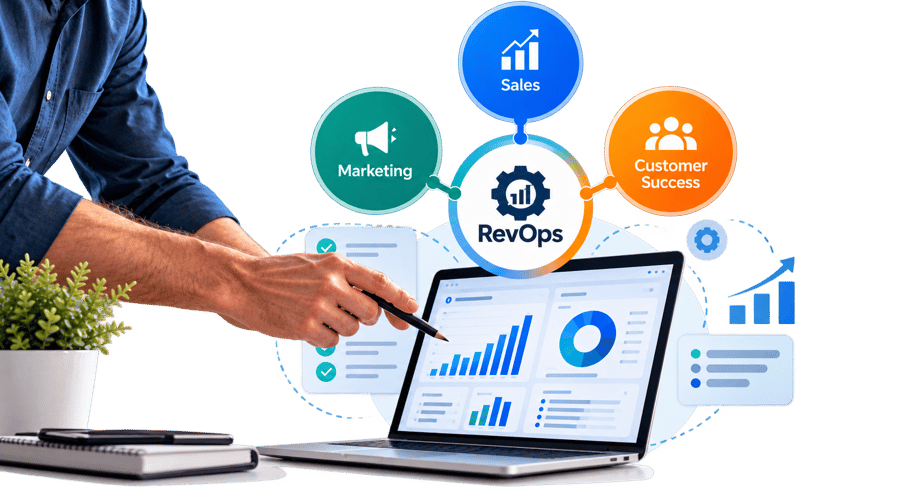
Marketing, sales, and customer success teams depend on accurate data and coordinated processes to manage revenue performance. As organizations grow, differences in reporting, technology, and departmental workflows can make forecasting and customer management more difficult.
Revenue Operations (RevOps) addresses these challenges by aligning the people, processes, systems, and data involved in generating and retaining revenue.
With a RevOps strategy, organizations can improve forecasting accuracy, strengthen coordination between departments, and establish more consistent revenue management practices.
This article explains how Revenue Operations works, what responsibilities it includes, and how to determine the right approach for your organization.
What is Revenue Operations?
Revenue Operations is a business strategy and operational framework that aligns marketing, sales, customer success, systems, reporting, and revenue processes into a unified function focused on improving revenue performance.
RevOps establishes shared processes and reporting standards that allow revenue teams to evaluate performance using consistent information. It also coordinates CRM management, automation, and operational workflows throughout the customer lifecycle.
Unlike department-specific operations functions, RevOps considers how decisions made by one team affect the performance of others.
A Revenue Operations strategy typically includes:
- CRM and revenue system management
- Marketing and sales alignment
- Customer lifecycle visibility
- Revenue forecasting and reporting
- Lead management and automation
- Customer onboarding coordination
- Workflow optimization
- AI-ready operational infrastructure
The Three Pillars of Revenue Operations
Every RevOps strategy is built around three core pillars:
- People
Aligning marketing, sales, and customer success teams around shared goals, accountability, communication, and revenue performance. - Process
Standardizing how leads move through the funnel, how opportunities are managed, and how customers are onboarded, supported, and retained. - Technology
Connecting CRM systems, marketing automation platforms (MAPs), business intelligence (BI) tools, customer success platforms, and AI-driven workflows into a unified revenue ecosystem.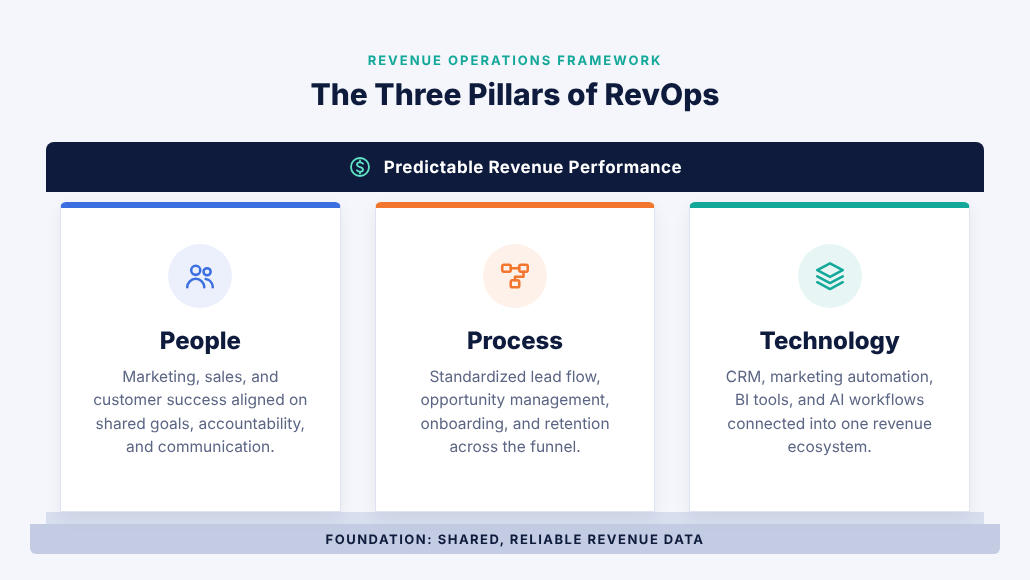
A Brief History of Revenue Operations
Revenue Operations developed as businesses recognized the limitations of managing marketing, sales, and customer success operations independently. Separate reporting systems, performance metrics, and workflows made it difficult to evaluate revenue performance throughout the customer lifecycle.
As buying processes became more digital and businesses adopted additional technology platforms, the need for coordinated revenue management increased. RevOps emerged as a framework for managing these functions together.
The Core Functions of Revenue Operations
RevOps is not a single task or role. Mature RevOps organizations typically operate across five core operational functions:
1. Data & Analytics
RevOps establishes consistent data standards and reporting practices so leadership can evaluate revenue performance with greater confidence. This includes bringing CRM, marketing, sales, and customer success information into dashboards that support forecasting and operational decisions.
Key responsibilities include:
-
Defining and maintaining GTM metrics (Marketing Qualified Lead, Sales Qualified Lead, pipeline coverage, Customer Acquisition Cost, Net Revenue Retention)
- Building dashboards and reports for sales, marketing, and CS leadership
- Conducting win/loss and cohort analyses to identify revenue patterns
- Ensuring data hygiene across the CRM and connected tools
2. Process Design & Standardization
RevOps develops standardized workflows and lifecycle processes that improve operational consistency across the customer journey.
This may include:
- Lead routing rules
- Lifecycle stage definitions
- Sales pipeline management
- Customer onboarding workflows
- Handoff processes between marketing, sales, and customer success
- Renewal and expansion workflows
Documented processes establish consistent expectations for CRM updates, lead management, and customer handoffs. This improves data reliability and reduces the need for manual corrections.
3. Technology & Systems Management
Revenue Operations teams often oversee CRM systems, marketing automation platforms (MAPs), integrations, reporting tools, workflow automation, and customer success platforms.
Common RevOps technologies include:
- HubSpot
- Salesforce
- Marketo
- Tableau
- Looker
- Clari
- Gong
- Outreach
- Salesloft
4. Revenue Forecasting & Pipeline Management
Revenue Operations supports forecasting by establishing consistent pipeline definitions, monitoring revenue performance, and improving the quality of information used in financial planning.
RevOps helps leadership teams better understand:
- Pipeline health
- Deal velocity
- Conversion rates
- Revenue trends
- Forecast accuracy
- Expansion opportunities
- Customer retention performance
This improves executive visibility and supports more predictable revenue planning.
5. Enablement & Productivity
Revenue Operations supports the adoption of systems and processes used by customer-facing teams. This may include CRM training, documentation, and guidance on reporting and workflow management.
Many RevOps teams support:
- Sales enablement
- CRM adoption
- Workflow training
- Process documentation
- Reporting adoption
- Operational onboarding
Who Does Revenue Operations Serve?
Revenue Operations supports the teams responsible for managing revenue performance, as well as the executives who rely on accurate financial and operational reporting.
- The CRO & Revenue Leadership Team
RevOps acts as the operational engine behind the Chief Revenue Officer’s (CRO) strategy. It translates revenue goals into measurable pipeline targets, tracks performance across the GTM organization, and provides the visibility leadership teams need for forecasting and strategic decision-making.
- Sales, Marketing & Customer Success Teams
Revenue Operations supports these teams by establishing shared data standards, improving customer handoffs, and maintaining the systems used to manage leads, sales activities, and customer relationships.
- The CFO & Finance Team
Revenue predictability is ultimately a finance priority. RevOps helps finance leaders model revenue more accurately, connect GTM investments to business outcomes, and make informed decisions about headcount and spend.
The Business Benefits of Revenue Operations

Revenue Operations can improve financial performance by addressing inefficiencies in how organizations manage sales processes, customer relationships, and revenue data. The following benefits demonstrate its potential impact.
- Faster Deal Cycles
Automated lead routing and defined handoff procedures can reduce delays between initial inquiries and sales follow-up. Sales representatives also benefit from having access to relevant customer information when evaluating prospects and advancing deals.
- Improved Win Rates
Consistent sales processes and better pipeline reporting allow managers to identify where deals stall and which activities contribute to successful outcomes. These findings can inform sales coaching and improve conversion rates.
- Better Forecasting Accuracy
Consistent pipeline definitions, reliable CRM data, and historical performance analysis provide a stronger foundation for revenue forecasting. Leadership can evaluate projected revenue using standardized information and identify potential gaps earlier.
- Improved Customer Experience & Retention
Customer success teams need accurate information about customer expectations, purchased services, and commitments made during the sales process. RevOps establishes handoff procedures that preserve this information, supporting more coordinated onboarding and stronger customer relationships.
- Scalability
As organizations expand into additional markets, introduce products, or add team members, revenue processes become more complex. Established workflows, standardized reporting, and coordinated systems allow businesses to manage that complexity without continually rebuilding their operations.
RevOps vs. Sales Ops vs. Marketing Ops
One of the most common questions about RevOps is how it differs from existing operational functions. While Sales Operations and Marketing Operations optimize individual departments, Revenue Operations aligns the entire revenue lifecycle across marketing, sales, customer success, forecasting, reporting, and customer retention.
Here's a side-by-side comparison:
|
Function |
Sales Ops |
Marketing Ops |
Revenue Ops |
|
Focus |
Sales team efficiency |
Lead gen & campaigns |
Full revenue lifecycle |
|
Scope |
CRM, forecasting, quota |
MAP, attribution |
Unified GTM strategy |
|
Data |
Sales & pipeline data |
Campaign & lead data |
Unified revenue data |
|
Owner |
VP/Dir of Sales Ops |
Marketing Ops Manager |
CRO / VP RevOps |
|
Primary Objective |
Improve sales execution |
Improve marketing performance |
Optimize revenue operations |
Signs Your Company Needs RevOps
Some organizations already perform Revenue Operations activities without having a dedicated RevOps team. Others may benefit from a more structured approach to managing their revenue processes. Common indicators include:
- Sales and marketing disagree on what a qualified lead means
- Forecasting feels like a negotiation instead of a data-driven process
- CRM data is inconsistent or unreliable
- Customer data exists across disconnected systems
- Customer success teams lack visibility into what was promised during the sales process
- Reporting requires excessive manual work
- Teams rely heavily on spreadsheets instead of centralized reporting
- Marketing, sales, and customer success use different reporting structures
- Customer acquisition cost (CAC) can’t be reliably measured by segment
If your organization experiences several of these challenges, a RevOps assessment can identify where improvements in processes, systems, or reporting may be beneficial.
How to Get Started with RevOps
By Company Stage
The appropriate RevOps structure depends on organizational complexity, available resources, and the systems already in place. The following examples illustrate how Revenue Operations responsibilities may change as businesses expand.
|
Stage |
Typical Setup |
First RevOps Move |
|
Startup |
Founder or sales leader manages operations |
Clean the CRM; define lead stages; pick one dashboard |
|
Growth |
Dedicated sales or marketing operations support |
Establish shared metrics & coordinate operational responsibilities |
|
Scale |
Multiple ops specialists per team |
Evaluate dedicated RevOps leadership & integrated forecasting |
The RevOps Maturity Model
Revenue Operations capabilities typically develop in stages as organizations establish processes, improve data management, and expand their use of automation and reporting. The following model illustrates common levels of operational maturity.
|
Stage |
🐛 Crawl |
🚶 Walk |
🏃 Run |
|
People |
Ops within each team |
Shared ops resources |
Dedicated RevOps org |
|
Data |
Siloed in each tool |
Some integration |
Unified data layer |
|
Process |
Ad hoc |
Documented basics |
Standardized & measured |
|
Tech |
Multiple independent tools |
Partial integration |
Fully integrated stack |
|
Forecast |
Informal estimates |
Basic pipeline review |
Predictive modeling |
Key Metrics to Establish from Day One
Revenue Operations teams should establish baseline metrics that reflect their organization's sales process and revenue model. Common measurements include:
- Lead-to-MQL conversion rate
- MQL-to-SQL (sales qualified lead) conversion rate
- SQL-to-Closed Won conversion rate
- Average sales cycle length
- Customer Acquisition Cost by channel and segment
- Average Contract Value (ACV) and Average Revenue Per Account (ARPA)
- Net Revenue Retention (NRR)
- Time to first value/onboarding completion rate
- Forecast accuracy (actual vs. projected revenue)
The Future of Revenue Operations
As businesses place greater demands on their revenue operations, advances in technology are changing how teams manage data, automate processes, and evaluate performance. Artificial intelligence and more sophisticated reporting capabilities are expanding what organizations can accomplish with their existing revenue systems.
AI and Predictive Intelligence
Artificial intelligence is expanding how Revenue Operations teams analyze pipeline activity, customer engagement, and historical performance. AI-enabled CRM and reporting tools can identify patterns in revenue data, flag potential risks, and support more informed forecasting.
For organizations using HubSpot, AI capabilities can complement existing workflows and reporting processes, although available functionality depends on the tools and subscription levels in use.
AI-enabled Revenue Operations tools can support activities such as:
- Predicting deal outcomes
- Improving forecasting accuracy
- Identifying churn risks
- Automating lead routing
- Analyzing customer engagement trends
- Improving reporting insights
- Surfacing operational bottlenecks faster
Greater Integration of Revenue Data and Systems
As organizations adopt more sophisticated reporting and automation capabilities, Revenue Operations will play an increasingly important role in managing how information moves between departments. Shared data standards and integrated systems can give revenue leaders a more complete picture of pipeline activity, customer relationships, and financial performance.
This increased visibility can also support more advanced forecasting and earlier identification of customer retention risks. Businesses with well-managed CRM data and documented processes will be better positioned to take advantage of these capabilities as revenue technologies develop.
Frequently Asked Questions About Revenue Operations
What is Revenue Operations?
Revenue Operations aligns marketing, sales, customer success, systems, reporting, and operational processes to improve revenue growth and customer lifecycle performance.
What does a RevOps team do?
A RevOps team manages forecasting, CRM systems, reporting, automation, customer lifecycle visibility, and operational alignment across the GTM organization.
What is the difference between Revenue Operations and Sales Operations?
Sales Operations focuses primarily on improving sales processes, pipeline management, and sales team performance. Revenue Operations has a broader scope, coordinating operational processes throughout marketing, sales, and customer success.
Why is Revenue Operations important?
Revenue Operations improves forecasting accuracy, customer experience, operational efficiency, and scalability while helping organizations make more informed business decisions.
What tools are commonly used in Revenue Operations?
Revenue Operations teams commonly use CRM platforms, marketing automation software, revenue reporting tools, and sales enablement systems. HubSpot provides an integrated platform for managing many of these functions, including CRM data, workflow automation, pipeline reporting, and customer lifecycle management.
Can small and mid-sized businesses benefit from RevOps?
Yes. RevOps helps organizations create scalable systems earlier in their growth journey while improving visibility, alignment, and reporting consistency.
How does RevOps improve customer experience?
Revenue Operations helps standardize customer handoffs, lifecycle visibility, onboarding, and communication across marketing, sales, and customer success teams.
Strengthen Your Revenue Operations with Xcellimark
An effective Revenue Operations strategy begins with understanding how your current processes, systems, and reporting support revenue performance.
Xcellimark provides HubSpot Revenue Operations services that improve CRM configuration, reporting, workflow automation, and coordination between revenue teams.
Contact Xcellimark to discuss your Revenue Operations needs and how our team can support your next steps.